Most business websites have service pages, but very few are actually optimized to rank.
That is where the gap lies.
An unoptimized service page simply lists what you offer. An optimized one works as a lead-generating asset, bringing in traffic from people who are actively searching for your services.
If your website is not consistently bringing in organic leads, your service pages are one of the first places to look.
Why Service Pages Are the Core of Organic SEO
Your homepage cannot rank for everything.
People do not search for your business name unless they already know you. Instead, they search for services. Someone in Kitchener is typing queries like “bathroom renovation Kitchener,” “barber near me,” or “furnace repair Waterloo.”
Google’s job is to match those searches with the most relevant page.
If you do not have a dedicated, optimized page for that service, you are unlikely to rank.
This is why service pages are the foundation of organic visibility.
What Makes a Service Page “Optimized”
An optimized service page is built around how people search, not just what you want to say.
It clearly communicates:
- What the service is
- Who it is for
- Where it is offered
- Why your business is the right choice
More importantly, it aligns with search intent, which is what Google prioritizes.
Google rewards pages that directly answer user queries. If your page matches the intent behind a search, your chances of ranking increase significantly.
How Optimized Service Pages Improve Visibility
When your service pages are properly structured, your website starts appearing in more searches.
This happens because each page targets a specific keyword and location combination. Instead of relying on one page to rank for everything, you create multiple entry points into your website.
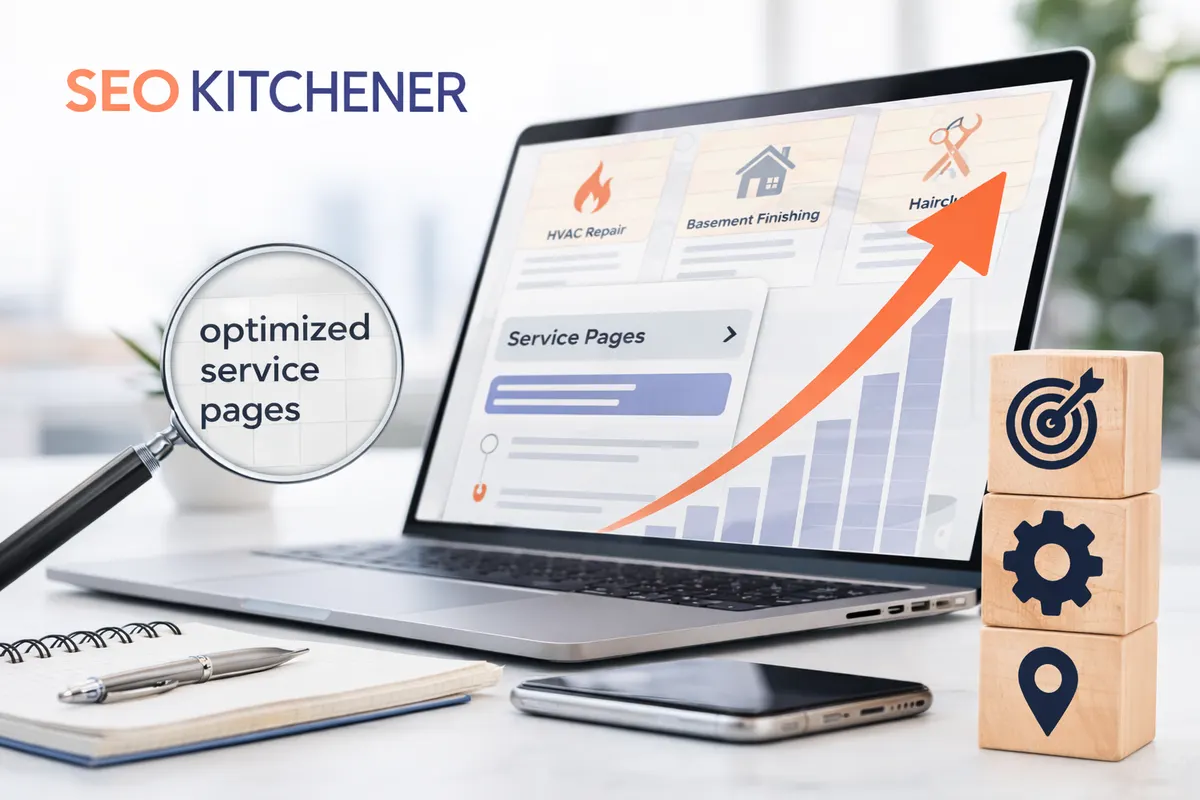
A well-optimized site might include pages like:
- Kitchen renovation Kitchener
- Basement finishing Waterloo
- Men’s haircut Cambridge
Each of these pages increases your chances of being discovered.
More optimized pages mean more visibility across different searches.
The Direct Connection Between Service Pages and Rankings
Google evaluates your pages based on relevance, clarity, and depth.
An optimized service page strengthens all three.
It uses clear headings, structured content, and natural keyword placement. It also includes location signals, helping Google understand where your services are offered.
Location relevance is critical for local SEO. Without it, even a well-written page may struggle to rank in your target area.
In addition, well-optimized pages improve indexing. Google can crawl and understand your site more efficiently, which increases your chances of appearing in search results.
How Service Pages Turn Traffic Into Leads
Visibility alone does not grow a business. Conversions do.
This is where optimized service pages make a real difference.
When a user lands on a page that exactly matches their search, there is no confusion. They do not need to navigate your site or figure out if you offer the service. They are already in the right place.
A strong service page:
- Builds trust quickly
- Answers common questions
- Shows expertise
- Guides the user toward contacting you
Clarity reduces friction, and less friction leads to more inquiries.
Why Content Depth Matters More Than Ever
Thin pages do not perform well anymore.
Google prefers pages that provide complete, useful information. A good service page goes beyond a basic description. It explains the service, highlights its benefits, and addresses what customers are actually looking for.
For example, instead of simply stating “we offer HVAC repair,” a strong page will explain common issues, service process, and what customers can expect.

Depth signals authority, and authority improves rankings.
The Role of Internal Linking and Structure
Service pages do not work in isolation.
When properly connected, they strengthen your entire website. Internal linking helps Google understand the relationship between your pages and distributes authority across your site.
It also improves user experience. Visitors can easily explore related services, which increases engagement and time on site.
A well-structured website performs better in both rankings and conversions.
Common Mistakes That Limit Results
Many businesses create service pages but miss the opportunity to optimize them properly.
Some pages are too generic, while others try to cover multiple services at once. In many cases, there is little to no location relevance, or the content is too short to provide value.
The biggest issue is that these pages are not aligned with how people actually search.
Without alignment, even a good-looking page will not perform.
Why This Matters in Competitive Markets Like Kitchener
In a market like Kitchener, visibility is competitive across industries.
Many businesses still rely on basic websites with minimal optimization. This creates a clear opportunity.
Businesses with well-optimized service pages consistently outperform those without them.
Google is not just ranking businesses. It is ranking pages. The more relevant and optimized your pages are, the stronger your position becomes.
The Bigger Picture of SEO Growth
Service pages are not just individual assets. They are part of a larger SEO system.
When combined with:
- A well-optimized Google Business Profile
- Consistent reviews
- Strong citations
- Ongoing updates
They create a powerful foundation for long-term growth.
Each element supports the other, but service pages are often where the actual ranking happens.
Optimized service pages are one of the most direct ways to improve organic visibility.
They help you rank for real searches.
They bring in high-intent traffic.
And they convert visitors into leads.
If your website is not generating consistent results, your service pages are not just underperforming, they are underutilized.
Fixing them is not complicated, but it requires the right approach and consistency.
Want this handled for your business?
Everything in this guide is part of what we do for Kitchener businesses every day. Get a free audit of your online presence and a clear action plan within 48 hours.
Get a Free SEO Audit